Showing posts with label american history. Show all posts

Friday, September 9, 2016

Social Institutions of the United States: Change Over Time Starting with the Colonial Era

     As young historians, students examine change over time beginning with the earliest days of European colonization in North America. State standards highlight that students should be able to describe the development of social and political institutions.

What are social and political institutions?
People are different in every era.  Our modern social beliefs and norms evolved over time and they're connected to our nation's past. Who we are today is related to who we were in the past. Investigating the social beliefs and norms of the colonial era allows students to understand “what life was like long ago”, thereby providing historical context so students can explain how we have changed over time. Socially, we want students to explore a variety of social beliefs and norms. This might involve investigating gender roles, norms for adults or children, and the creation of class systems in our past and present.    We also want students to recognize that different beliefs have always been a part of our society and they have also changed over time. Scientific beliefs and practices have changed over time...so have religious beliefs and practices. Events such as the Enlightenment and the Great Awakening provide unique insight into our nation's scientific and religious history. Through a social lens, students are able to understand that we have modern social beliefs and norms that have changed over time...and the present is connected to the past. Some things change, some things stay the same. (Think about ordering A Day in the Life to help students develop social context of the colonial era.)
Second, we have developed beliefs and norms related to governing ourselves. Historians describe this as political change over time. Today, we have certain political beliefs such as 1) a limited government elected by the people and informed by the people, 2) embracing conflict and compromise as we collaborate to create political change, 3) government guided by a constitution, and 4) a balance of power and authority grounded in checks and balances.  Our beliefs of today have evolved over time and they’re connected to our nation’s past. In the past, the Mayflower Compact was one of the first forms of collective agreement established so citizens would be connected around common beliefs, rules and laws.  In colonial New England, there was little distinction between faith and community. Therefore, meetinghouses were built by the communities and used by everyone for both religious worship and town business related to governing citizens. This reflects the beginning of a democracy. For many colonies, the election of officials began to take place...a practice that was new and elevated the value of citizen input in government.  The way we operate today evolved over time.  To facilitate students in learning about this form of change over time, we look at the colonial era through a political lens.

What does this look like with 5th graders?
As teachers, we are going to pull as many primary sources as possible. Primary sources are at the heart of history instruction. Here are some ways to use primary and secondary sources to help students understand social and political change over time:

Questions to Guide Inquiry:

  • What social and political institutions (customs, beliefs, and norms) existed for people of North American in the 15th-17th centuries? How and why did they develop and change over time?
  • Why do historians use primary and secondary sources to construct understanding of the past?

  1. Students use a secondary source to investigate the big picture of life in the past with the book If You Live in Colonial Times by Ann Mcgovern. Students use different portions of the book to explain how life has changed over time and why.
  2. Students investigate the roles of men, women, and children in the past with the secondary sources in this lesson (Lesson: What was everyday life like in colonial Virginia?) Discuss how roles have changed over time and why.
  3. Students investigate social class in the colonial era with the primary and secondary sources (Social Class in Colonial America). Teachers might also use this site
  4. Students investigate a year in the life of a colonial farmer with a primary source (A Year in the Life of Thomas Minor). The language is tough but students can get the gist of this citizen's patterns of life. Students compare this person's patterns with the yearly patterns of a modern citizen or farmer and discuss how things have changed over time and why. 
  5. Students investigate rules of the past with this primary source (Rules of Civility and Decent Behavior in Company and Conversation). Discuss how rules have changed over time and predict why. 
  6. Students investigate one community's rules through primary sources (Rules, Rules, Rules). Today, we create rules for different communities. Students might describe how rules have changed over time and why. 
  7.  Students investigate communication in the past with this lesson using primary sources (Colonial Newspapers and Communication). Analyze the sources and discuss the topics that were "newsworthy" in the past versus today. Discuss how we share information today versus in the past. Discuss why these changes have taken place.
  8. Students investigate the items that people have in their homes through this lesson using probate inventories (How do we know about Colonial life?) Discuss what we might infer about the daily life from analyzing the inventories. Students create a list of what they have in their home and discuss what it tells them about life today. Discuss why things have changed over time.
  9. Students investigate how students new to a culture are educated through this primary source based lesson (Indian Boarding School). Discuss what school looks like today for students new to the United States. Discuss why things have changed over time.
  10. Students investigate medicine and science of the past by examining primary source artifacts. (Explanation of Apothecary and make sure you access the slideshow at the bottom of the page).  Students explain how the tools and approaches to medicine have changed over time and why. This is AWESOME!
  11. Students investigate how our knowledge of science and our response to illness has changed over time. Use this primary source lesson on Smallpox Inoculation
  12. Students investigate the Salem Witch Trials with this dot game from TCI. In the past, people were questioned if they had beliefs that differed from common religious beliefs. Today, we try to have a society that separates church and state. The way we address differences in belief looks different today as compared to the past.

What skills or discipline-specific thinking practices might I elevate?
Our goal in education is to create experiences so students practice the skills and thinking practices of real-life practitioners. In this case, we often land on the skills and thinking practices of historians. With the above resources, some skills and thinking practices include:

  • Analyze and gather evidence from primary and secondary sources. (When analyzing these sources, students are either transfer and reapplying reading skills or incorporating analytical processes. See my blog post on Traditional Literacy and Visual Literacy for guidance on how to do this.)
  • Create timelines. (Students can create a simple timeline that shows the social and political aspects of past and the present. Students might also add predictions about the future if they want.)
  • Explain why social and political institutions change over time. ("Institutions" are norms, beliefs, and structures we've created as people in a society. Therefore, students are explaining how our social and political norms and beliefs have changed over time. There are so many options for kids showing this in creative ways including creating short videos and skits.)

How can I extend this learning and ask students to transfer this concept in authentic ways?
Social education is based in developing students who are going to be educated, involved citizens in our communities. We might consider some of the ways that we might make this learning relevant. Here are just a few ideas.

  • Invite members of a homeless shelter to come speak with the class.  Find out about challenges they face in supporting homeless people and how people can become involved in change. Use this as an opportunity to help kids consider the actions they might take to be part of social change.
  • Invite a social worker to come in and speak with the class about challenges faced by people of diverse ethnicities. Use this as an opportunity to help kids consider the ways they might share ideas and influence change.
  • Invite a local leader to come in and speak about the value of parks and community centers in people's lives. Encourage these leaders to talk about their future projects and how they hope those future projects support social development for the people in a community.
  • Invite some grandparents into the classroom to speak about their life experiences and how they've noticed social change over time. Use this as a launching off point to ask students, "When you look at the world today, what social changes do you think need to take place? What steps can you take to influence change that matters to you?"

Friday, May 24, 2013

Backwards Design and Concept-Based Assessment in "Changing Face of North America" (the colonial era)

Backwards design means that we develop the appropriate assessments for a unit of study so we can monitor the development of student learning.  Instead of creating an assessment to test what we taught, we must create assessments that assess what students are expected to know, understand, and be able to do.

As part of concept-based learning, we want to incorporate more opportunities to see if students have developed conceptual understanding.  In a 5th grade unit titled The Changing Face of North America (some districts still use the Eurocentirc title of Colonial America), students should walk away with deep understanding of social, political, and economic facets of this era. 

Colorado Academic Standards state that students should be able to explain the development of political, social and economic institutions in the British American colonies.  Notice how this standard implies deep conceptual knowledge.  A teacher can't create an assessment with fill-in-the-blank or true-false questions and come away knowing if students can EXPLAIN these ideas.

To approach this goal, consider this performance assessment that connects student understanding of political, social and economic institutions to the historical concept of continuity and change over time

Instead of saying, "What do I need to teach?", begin your own mental conversation by asking, "If I were the student, what learning experiences would I need to prepare me for this assessment?"  You may even go so far as to try and complete the assessment as an adult.   Once you sense the learning experiences that students need, you may have a better sense of how to construct learning in a rigorous conceptual way.  (I suggest creating concept-based timelines as a tool for students.) It may not be easy at first, but we must move beyond the days of assessment that's about regurgitating facts...we must move to assessment that causes students to use facts to explain more complex concepts.

Thursday, September 6, 2012

Constructing History - Like Making Sense of a Collage

Historians agree that history is not a memorization of events, people, dates, etc.  Historians also agree that one facet of historical thinking involves students constructing history.

As I was thinking about this process, TO CONSTRUCT HISTORY, I discovered a metaphor that seemed to make sense.

Imagine an assignment where students are often asked to take a poster and answer the question, "Who are you?" by making a collage using words and images from magazines.  The student pores through magazines, cutting, pasting and organizing until the collage is a masterpiece.  Even when finished, the collage doesn't communicate everything that can possibly be share about the individual, but it's a wonderful start.  For a twist, I'm going to change how the poster is shared with others.  Instead of letting the student present his/her own poster, imagine the teacher asking everyone in the class to make sense of the collage with this assignment:
Your job is to look at the evidence that is on the poster and create a brief narrative about this person based on what you see on the collage. Your narrative should tell me who this person IS.
                                         
"Words to Live By", Anne B.'s Vision Board, Collage, 16 x 20 inches, January 2012. Anne's board is composed of 50 images; 48 of which are words or phrases!

 I see this activity as a precise metaphor for what we want students to do when they construct history.  Students should be taking all of the evidence that they have about a person, event, idea, or time period and make sense of it through considering how the different pieces and parts are connected.  Connecting these pieces and parts involves high levels of critical thinking.  Everyone will come up with different answers, which may be uncomfortable for a teacher who expects one common answer, but the different answers reveal each student's ability to construct history based on the evidence they have in front of them.  If we don't let students construct history, then we leave them with snapshots of primary and secondary sources that have never been connected by the learner.  To me, this is one of the most important steps in historical thinking.

What might this look like in a classroom?  (As a note, I'm presenting ideas that are created for the sole intent of causing teachers of history AND historical thinking to consider how this might play out in a classroom.  This is the product of my own reflection about quality instruction within history.)

First, I would want to use the timeline as a primary tool to keep track of the historical pieces of evidence.  (Side Note: Timelines are, too often, tools that teachers use ineffectively.  They end up being products instead of tools.  We don't have a hammer, whisk, or spatula to look at -  they are tools.  Timelines must be created so they can be used as tools for the historian.)  The timeline creates a holding place for a historian to keep track of historical evidence connected to people, events, and ideas over time.  As students examine different sources, whether primary or secondary, they add pieces of evidence to the historical story we want young historians to tell.

For example, let's take a set of sources connected to the Stamp Act.

For most of the nation, student learn about early American history in 5th grade.  As a class, the kids may have experienced different levels of support as they learned about the Stamp Act with each of these sources.  Upon finishing this, I see a timeline with images or notes about each of these sources.  To involve students in the critical historical thinking and the sense making process, their final task (in groups or on their own) might be:
Your job is to look at the evidence that is on your timeline and create a brief narrative describing the Stamp Act based on these sources. 

While this process would definitely include modeling by the teacher and strong application of the gradual release of responsibility, this opportunity for writing to learn is an essential part of learning.  Students must be involved with authentic writing in all contents.  Take a look at the following graphic that compares writing to learn vs learning to write.  The process of constructing history is 100% connected to writing to learn.


Constructing history is something that is done by students, grounded in historical critical thinking.  It involves the teacher giving up responsibility for telling the story and giving that responsibility over to the students.  No matter what the final product happens to be, it will be connected to true educational goals - students engaged in critical thinking, sense making, and communicating their ideas based on evidence.


Tuesday, August 14, 2012

Colonial America - Walk Back In Time

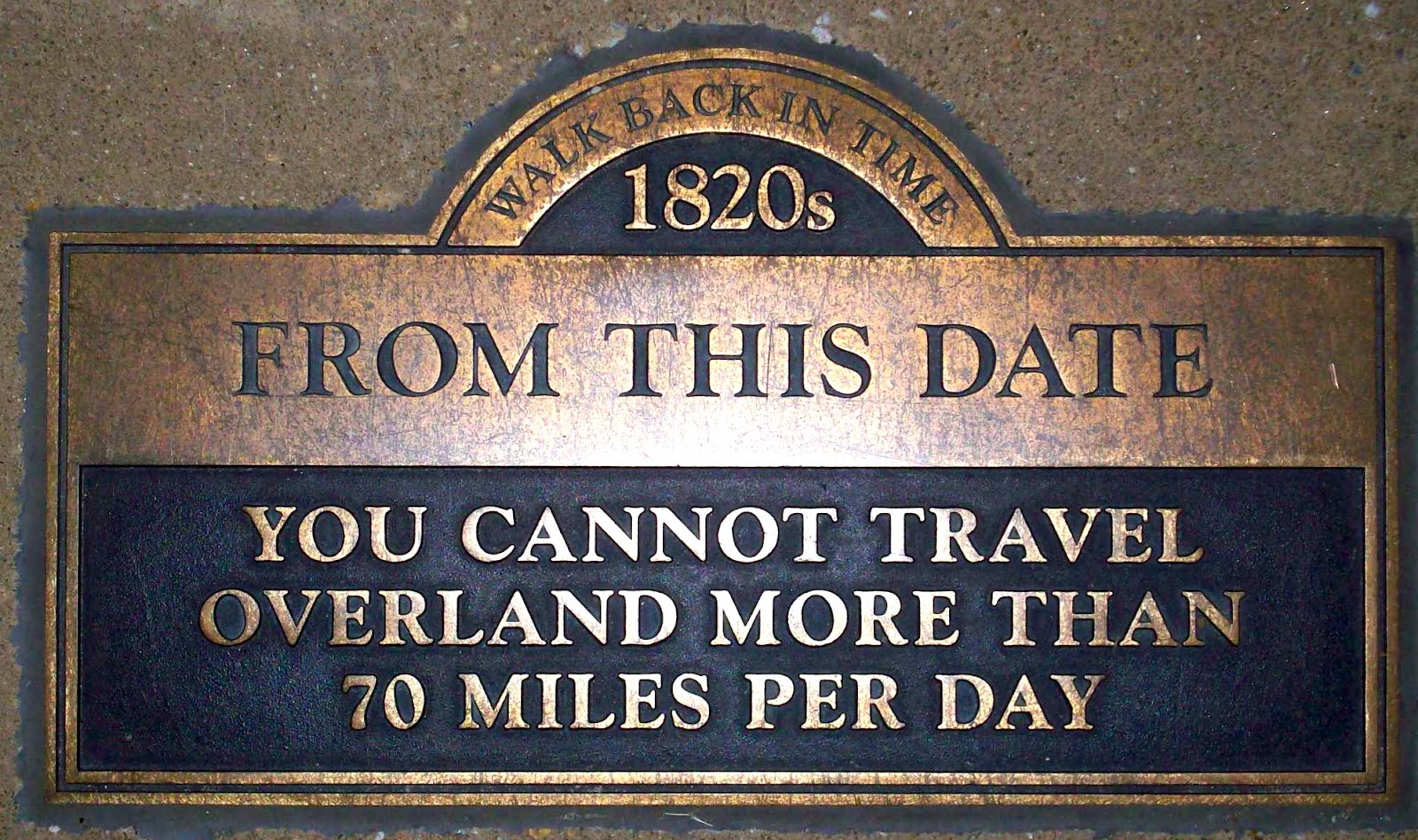
When I visited Colonial Williamsburg with a group of Jeffco teachers back in 2009, we took a walk along a bridge that contained a collection of plaques identifying dates and statements that would offer the viewer a sense of historical context.  For example, one said...


 1820's - You cannot travel overland more than 70 miles in a day.

There were a total of 12 plaques extending from the 18th Century to the 1980's.  
VIEW Document with Plaque Images.  (These are my personal photos taken at Colonial Williamsburg.  Feel free to use in any way to support instruction.)

I imagined using these plaques with 5th graders, the grade that frequently studies early American History throughout the United States.  5th graders struggle with their sense of time, and I thought to myself, "These plaques could be a great way to help kids connect with the past." When their sense of time is confined to the last 11 years, this provides the opportunity to walk back in time, just as was intended by Colonial Williamsburg.  

Within instruction, images of the plaques might be used at the start of a study to help students develop the concept of Chronology.  By placing the events on a timeline, students can be given guidance related to skills, such as, "Students will be able to determine critical attributes of a timeline."  Teachers can also engage students in discussion related to how historians use timelines to record people, events, and ideas.  Instructionally, after placing all of the events from the plaques on the timeline, students might be encouraged to place additional comments extending from the 1980's to the present (mirroring those on these plaques).  Some students might also enjoy the challenge of adding details from the beginning of the 18th century to the present.  There are definitely tons of options for extending the learning so students further develop their sense of time and Chronology.

Last, I can also see how these plaques can be used to help students develop the concept of Continuity and Change Over Time.  With each plaque, students could evaluate the statement to identify how things have changed and how things have stayed the same (of course, students will probably need support to begin thinking this way).

Example:
1820's - You cannot travel overland more than 70 miles in a day.
How have things stayed the same?

  • We still travel overland.
  • Most people travel overland less than 70 miles in a day driving to work.
  • People travel to destinations for particular reasons.

How have things changed?

  • People travel over land, over water, and even underground on trains and subways.
  • To travel 70 miles in a day is easy, and people will sometimes travel much greater distances over land in a day.  
  • Roads are not dirt, they're smoother for travel due to concrete and blacktop.

Thursday, May 10, 2012

Issues of Cobblestone Connected to 5th Grade Social Studies

First, I want to identify the topics that are associated with 5th grade in my school district (Changing Face of North America AKA Colonial America, American Revolution, United States Constitution).

With that in mind, I've created a document that includes the links/synopsis of all issues of Cobblestone that are connected to 5th grade social studies.  As teachers look to maximize learning time and connect learning across contents, there is a growing need to use content-rich non-fiction within reading instruction.  I feel that Cobblestone, a history magazine for ages 9-14, delivers wonderful non-fiction that is short enough to use with guided reading groups or for jigsaw reading activities around a topic/theme/concept.

Tuesday, May 1, 2012

Concept-Based Performance Assessment for Colonial America

With the elevation of concept-based learning, student assessment must consider transfer of concepts.  5th graders throughout the nation are involved in the study of Colonial America.  (Out of respect for cultures, we have renamed this unit Changing Face of North America: Emergence of a New World Society.)

As part of this study, students are engaged with the concept of continuity and change over time as it connects to social, political and economic development.  Essentially, students examine social, political and economic development over time to see what has stayed the same and what has changed.

Since 5th graders don't know much about different eras, the goal within this concept-based performance assessment (using the UbD GRASPS model) is to help them transfer the concept of continuity and change over time to a modern context.  And, since 5th graders might not know much about current social, political or economic perspectives, they build this knowledge through interviews with adults.  I just created this for our teachers, but it has not been tested.  What do you think?  Can 5th graders do this?  Check out the assessment here!

Sunday, April 29, 2012

George Washington's French and Indian War

In the intermediate grades, students work with perspective as a foundational thought process.  This causes a teacher to be well-versed in the events of a period.  This essay, George Washington's French and Indian War by Theodore J. Crackel, appears on the Gilder Lehrman website and examines one perspective in great detail.