Showing posts with label continuity and change over time. Show all posts

Thursday, September 25, 2014

Change - A Concept That Connects Science and Social Studies (and everything else in the world)

     A critical component of learning involves helping students to think conceptually. When we can provide opportunities for students to apply the same concepts across disciplines, we provide a pathway to deeper conceptual learning in ALL contents involved.

Let me provide an example:
     In 3rd grade, students in my school district have just finished a science unit called Change: Life Cycles. Students start October with a social studies unit titled The Big City. In this unit, students examine change over time in the Denver Metro area. Consider how we might incorporate a classroom experience that connects students to the deeper concept of change. Here is what this might look like and sound like:
Public domain image (from http://pixabay.com/)

TEACHER: "Students, in our last science unit, we learned about changes in plants and animals. All plants and animals change and we use the term life cycle to describe the series of changes organisms go through as they grow and develop. Can you share the changes that take place for a plant or an animal?"

STUDENTS: Students share their understanding of change from Change: Life Cycles.

TEACHER: "We are going to keep giving some examples of change.  Let's think about ourselves as readers, writers, and mathematicians. Can you tell me how you, as students, will change as a reader from Kindergarten to 6th grade? Can you tell me how you will change as a writer from Kindergarten to 6th grade? Can you tell me how you will change as a mathematician from Kindergarten to 6th grade?"

STUDENTS: Students share this understanding of change as it applies to them as readers, writers, and mathematicians.  Teachers might consider listing these on a simple timeline that shows the PAST and the FUTURE.

TEACHER: "Students, we are going to start a social studies unit where we look at change in the city where we live. I want you to put yourselves into the shoes of your grandparents when they were your age. That was probably a long time ago. Now, I want you to imagine what they would say if they could tell you how our city has changed over time.  You might use these two sentence starters to help you describe how our city has changed over time.  A long time ago....   But today,.... " Model what this thinking and writing looks like.

STUDENTS: Students take some time to write down some examples. (BEST PRACTICE ALERT) Since we know students learn with the use of nonlinguistic representations, you might show students how to create a past-picture and present-picture to illustrate one of their statements.  Encourage students to talk with each other and find out what other ideas their peers plan to share. When finished, students present their statements and illustrations.

TEACHER: Consider showing this brief video (also seen below) to help students sense some ways that Denver has changed over time. The video includes WHY changes have taken place.

Friday, May 24, 2013

Backwards Design and Concept-Based Assessment in "Changing Face of North America" (the colonial era)

Backwards design means that we develop the appropriate assessments for a unit of study so we can monitor the development of student learning.  Instead of creating an assessment to test what we taught, we must create assessments that assess what students are expected to know, understand, and be able to do.

As part of concept-based learning, we want to incorporate more opportunities to see if students have developed conceptual understanding.  In a 5th grade unit titled The Changing Face of North America (some districts still use the Eurocentirc title of Colonial America), students should walk away with deep understanding of social, political, and economic facets of this era. 

Colorado Academic Standards state that students should be able to explain the development of political, social and economic institutions in the British American colonies.  Notice how this standard implies deep conceptual knowledge.  A teacher can't create an assessment with fill-in-the-blank or true-false questions and come away knowing if students can EXPLAIN these ideas.

To approach this goal, consider this performance assessment that connects student understanding of political, social and economic institutions to the historical concept of continuity and change over time. 

Instead of saying, "What do I need to teach?", begin your own mental conversation by asking, "If I were the student, what learning experiences would I need to prepare me for this assessment?"  You may even go so far as to try and complete the assessment as an adult.   Once you sense the learning experiences that students need, you may have a better sense of how to construct learning in a rigorous conceptual way.  (I suggest creating concept-based timelines as a tool for students.) It may not be easy at first, but we must move beyond the days of assessment that's about regurgitating facts...we must move to assessment that causes students to use facts to explain more complex concepts.

Tuesday, August 14, 2012

Colonial America - Walk Back In Time

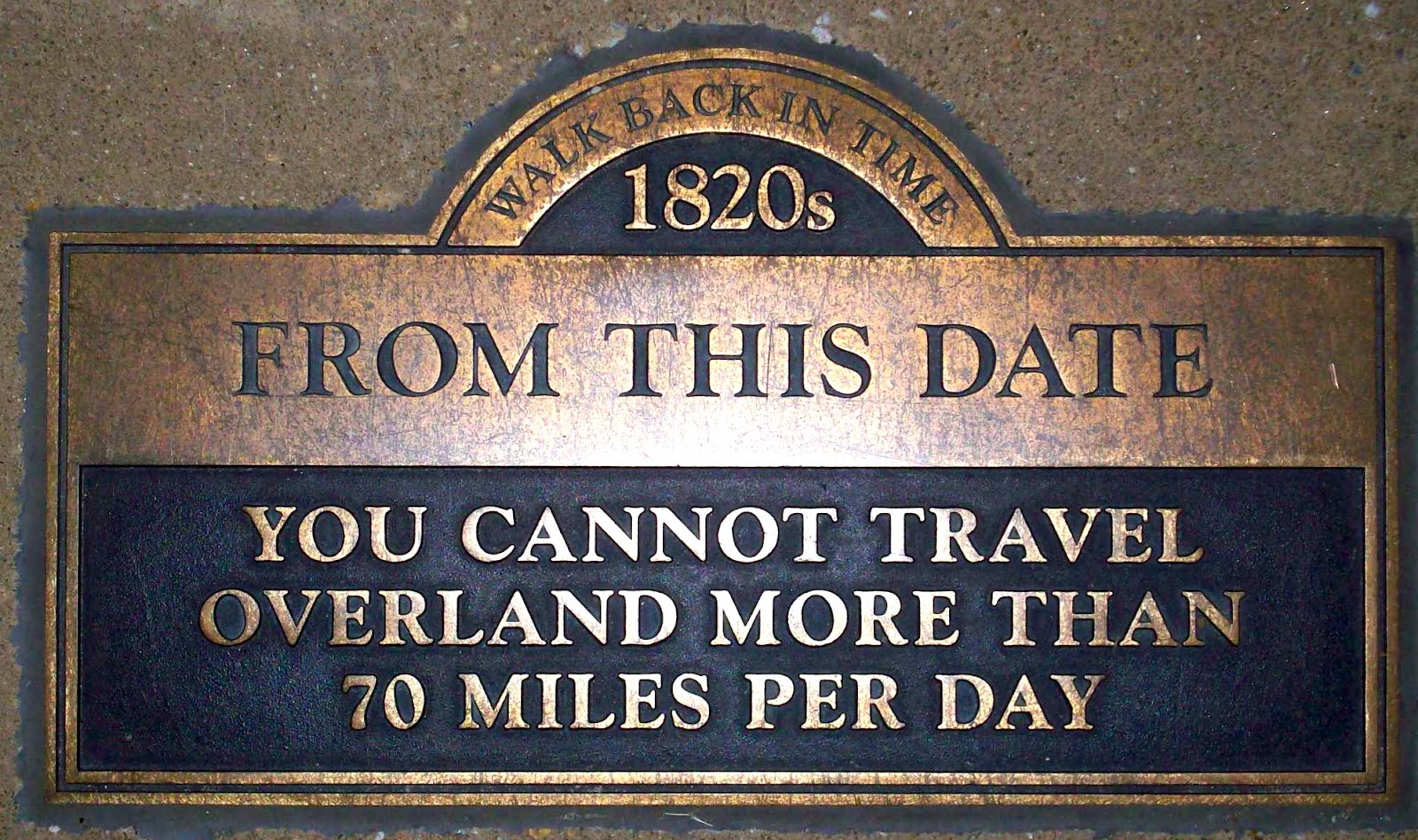
When I visited Colonial Williamsburg with a group of Jeffco teachers back in 2009, we took a walk along a bridge that contained a collection of plaques identifying dates and statements that would offer the viewer a sense of historical context.  For example, one said...


 1820's - You cannot travel overland more than 70 miles in a day.

There were a total of 12 plaques extending from the 18th Century to the 1980's.  
VIEW Document with Plaque Images.  (These are my personal photos taken at Colonial Williamsburg.  Feel free to use in any way to support instruction.)

I imagined using these plaques with 5th graders, the grade that frequently studies early American History throughout the United States.  5th graders struggle with their sense of time, and I thought to myself, "These plaques could be a great way to help kids connect with the past." When their sense of time is confined to the last 11 years, this provides the opportunity to walk back in time, just as was intended by Colonial Williamsburg.  

Within instruction, images of the plaques might be used at the start of a study to help students develop the concept of Chronology.  By placing the events on a timeline, students can be given guidance related to skills, such as, "Students will be able to determine critical attributes of a timeline."  Teachers can also engage students in discussion related to how historians use timelines to record people, events, and ideas.  Instructionally, after placing all of the events from the plaques on the timeline, students might be encouraged to place additional comments extending from the 1980's to the present (mirroring those on these plaques).  Some students might also enjoy the challenge of adding details from the beginning of the 18th century to the present.  There are definitely tons of options for extending the learning so students further develop their sense of time and Chronology.

Last, I can also see how these plaques can be used to help students develop the concept of Continuity and Change Over Time.  With each plaque, students could evaluate the statement to identify how things have changed and how things have stayed the same (of course, students will probably need support to begin thinking this way).

Example:
1820's - You cannot travel overland more than 70 miles in a day.
How have things stayed the same?

  • We still travel overland.
  • Most people travel overland less than 70 miles in a day driving to work.
  • People travel to destinations for particular reasons.

How have things changed?

  • People travel over land, over water, and even underground on trains and subways.
  • To travel 70 miles in a day is easy, and people will sometimes travel much greater distances over land in a day.  
  • Roads are not dirt, they're smoother for travel due to concrete and blacktop.

Friday, August 10, 2012

Using Photographs to Teach "Continuity and Change Over Time"

A significant history concept that students need to grasp is Continuity and Change Over Time.  This involves considering how people, ideas, and places have stayed the same and changed over time.  While explaining this concept is a start, we have to remember that many students are visual.  Luckily, there are picture sets that exist which allow us to guide students toward understanding this concept.  

Picture Set: Summer Olympics Since 1896 (from DZinepress)

How might I use a picture set within a learning activity?
If students are given this set of pictures, they might initially organize them on a timeline.  This opportunity deepens their sense of chronology and how timelines are used by historians.  For younger students who are still grasping concepts of time, they might add the birthdays of major family members or when particular items were invented.  Adding these elements help students to build context for time periods.  Finally, allow students to create a simple T chart with:
1. What appears to stay the same over time?
2. What appears to change over time?
  
This gets students actively involved in the historical process/historical thinking and creates an entry point for every student to apply the concept of Continuity and Change Over Time to their learning of history.  Students might add details that are complex or details that may appear, initially, surface level.  The ope-ended nature of the learning activity allows students of all learning levels to engage in the thinking and participate in the discussion of what was observed.

Keep your eyes out for additional picture sets that you might use.  In a 3rd grade classroom, a teacher used pictures of the Denver Bronco quarterbacks, the uniforms, and the stadium to help students understand the concept of Continuity and Change Over Time.

Tuesday, May 1, 2012

Concept-Based Performance Assessment for Colonial America

With the elevation of concept-based learning, student assessment must consider transfer of concepts.  5th graders throughout the nation are involved in the study of Colonial America.  (Out of respect for cultures, we have renamed this unit Changing Face of North America: Emergence of a New World Society.)

As part of this study, students are engaged with the concept of continuity and change over time as it connects to social, political and economic development.  Essentially, students examine social, political and economic development over time to see what has stayed the same and what has changed.

Since 5th graders don't know much about different eras, the goal within this concept-based performance assessment (using the UbD GRASPS model) is to help them transfer the concept of continuity and change over time to a modern context.  And, since 5th graders might not know much about current social, political or economic perspectives, they build this knowledge through interviews with adults.  I just created this for our teachers, but it has not been tested.  What do you think?  Can 5th graders do this?  Check out the assessment here!